
Is My Child Good at Art?
Maybe this isn't the question we should be asking
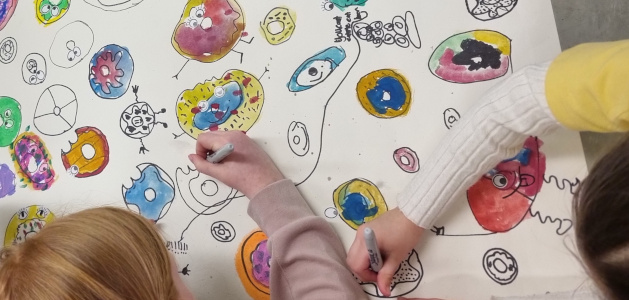
"Is My Child Good at Art?"
It sounds harmless enough, but this question suggests that the purpose of art is to produce something impressive. Perhaps a better question is:
"What is art doing for the child?"
I'm much more interested in what happens while students are creating art. Because that's where the real learning lives.
The biggest misconception about art? That you need to be good at it.
Many of us grew up believing that art was something you were either good at or not. You could draw... or you couldn't. You were artistic... or you weren't.
It's a belief that often starts young. Children quickly notice which classmates receive praise for neat colouring, realistic drawings or beautifully displayed work. Before long, many begin deciding whether they belong in the "good at art" group or not. But being skilled at drawing and being creative are not the same thing.
Drawing realistically is a technical skill. Like handwriting or learning multiplication tables, it can be taught, practised and improved over time.
Creativity is something different. It's about generating ideas, exploring possibilities, asking questions, solving problems and trying different approaches. When we only celebrate the finished picture, we risk overlooking all those other skills that matter just as much, if not more.
Art isn't important because of what children create.
Art is important because it of what creating does for children.
(This applies for adults too!)
Not every child who enjoys football becomes a professional footballer. Not every child who loves science becomes a scientist. We don't introduce music lessons because every child will become a concert pianist. We shouldn't judge the value of art solely by whether it produces talented artists!
Art deserves its place in education because it develops skills that reach far beyond the art room. Creative experiences encourage children to make decisions independently, cope with uncertainty, communicate ideas, collaborate with others and develop confidence in their own thinking.
Art builds life skills. Whether a child grows up to be an engineer, nurse, carpenter, teacher or designer, they'll benefit from learning how to think creatively and approach problems with curiosity. That's what art helps to develop.
Creativity isn't measured by how realistic a picture looks.
It's measured in curiosity, problem solving, imagination, risk taking and persistence.
Some of the most creative children I've taught didn't produce the neatest artwork. They were the children who asked, "What would happen if...?" The ones who mixed unexpected colours just to see what they'd make. The children who rebuilt their cardboard sculpture three times when roof kept collapsing. The children who completely changed direction halfway through because a new idea appeared.
Those moments can easily go unnoticed because they don't always result in the prettiest finished piece. But they are often where the richest learning happens.
Creativity is rarely tidy. It involves making mistakes, adapting, experimenting and sometimes starting again. Those moments of productive struggle are every bit as valuable as the artwork itself.
When children paint, build, draw, invent, sculpt and experiment, they're developing far more than artistic skills.
They're learning to make decisions. Trust their ideas. Adapt when things don't go to plan and think flexibly. This is one of the biggest reasons I love process art and open-ended creative experiences. When there isn't one correct outcome, children are constantly making choices.
Which materials will I use? How can I make this stand up? What could I try differently? Why didn't that work? Those small decisions build independence.
Instead of waiting for an adult to provide the next instruction, children begin finding solutions themselves. They learn that changing their mind isn't failure. It's part of the creative process. That flexible thinking transfers into many other areas of learning too.
With process art, the finished artwork isn't the focus. The child is.
This doesn't mean the artwork doesn't matter. Of course it does. Children deserve opportunities to learn artistic techniques, explore different materials and develop their practical skills. Technical teaching absolutely has a place.
But if every child produces an identical painting, collage or paper craft, it's worth asking whose ideas are we really celebrating?
When the adult has made every creative decision, children have very little opportunity to think creatively themselves. Sometimes the most meaningful art sessions produce work that looks completely different from one child to the next.
And that is exactly the point!
Different children notice different things. They have different experiences, different ideas and different ways of solving problems. Their artwork should reflect that.
The finished artwork only tells us a tiny part of the story. It doesn't show the child who finally found the confidence to make the first mark on the page. It doesn't show the child who kept trying after three failed attempts. It doesn't show the conversations, collaborations, questions or discoveries that happened along the way. Those moments are often invisible once the paint has dried. But they're arguably the most important outcomes of all.
As educators, and parents, it's worth paying attention to the process as much as the product. Sometimes even more!
Not every child will become an artist. But every child can benefit from art and creativity.
Most children's artwork won't still be hanging on the wall in ten years' time. But the confidence they gain from expressing an idea? The resilience they build through experimentation? The curiosity they develop by asking questions? Those qualities stay with them long after the paper has been recycled.



 Most Read


